Unveiling Cattleya violacea: The Majestic Superba del Orinoco
Unveiling Cattleya violacea: The Majestic Superba del Orinoco
Among the diverse world of South American orchids, few species command attention quite like Cattleya violacea. Affectionately known in Venezuela as "Superba del Orinoco," this striking bifoliate species is a prized gem for collectors and tropical plant enthusiasts alike. Below, we explore the essential characteristics, natural habitat, stunning color variations, and rich history of this legendary Cattleya.
Botanical Characteristics
Unlike classic unifoliate Cattleyas, Cattleya violacea stands out with its distinct structural growth and vibrant inflorescence:
Growth Habit: It is a true bifoliate species featuring elongated, cylindrical pseudobulbs topped with two rigid, leathery leaves.
Inflorescence: Each stem produces a cluster of 3 to 7 long-lasting, flat-opening blooms.
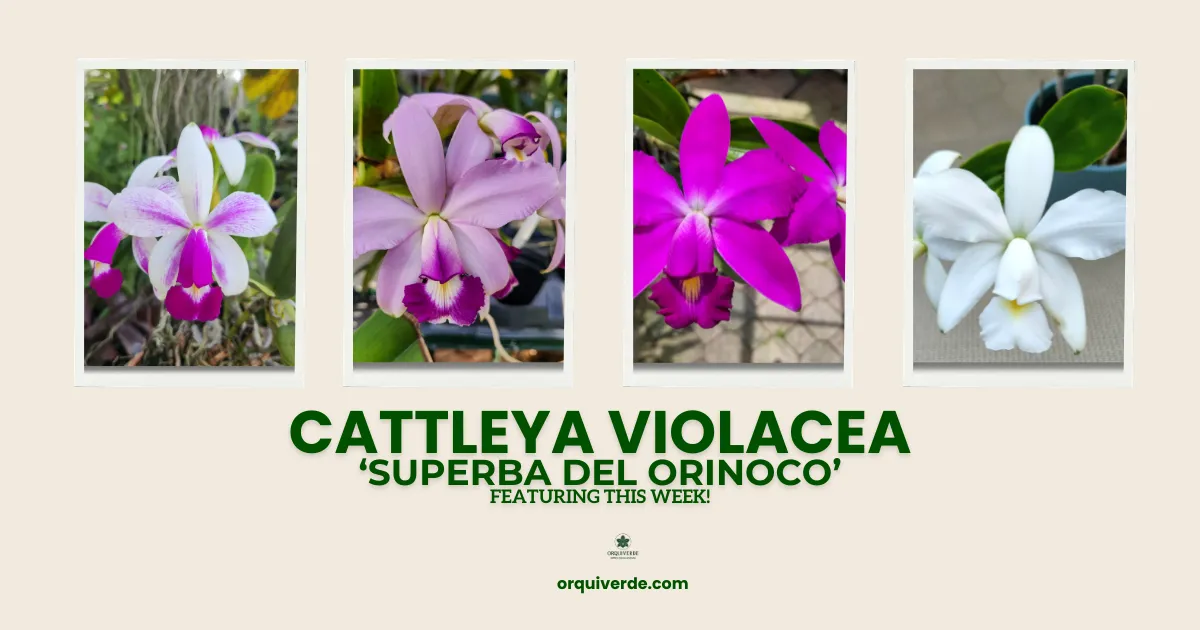
Flowers: Bright rose-purple to deep violet sepals and petals complement a intense crimson-purple lip, finished with delicate yellow and white center throat markings.
Fragrance: Flowers release an intensely rich, sweet perfume that fills warm growing spaces during peak bloom.
Habitat & Venezuelan Roots
While Cattleya violacea holds the distinction of having the largest geographical range of any Cattleya species—spanning across Venezuela, Colombia, and Brazil—it carries deep cultural and botanical roots along the river systems of Venezuela.
Thriving high up in the canopy of riverbank trees in the hot, humid lowland forests of the Orinoco and Amazonas basins, it relies on bright light, high humidity, and warm tropical temperatures year-round.
Color Varieties in Cultivation
While the classic tipical form displays brilliant magenta-purple tones, C. violacea offers remarkable color diversity for growers and species collectors:
Tipo: The traditional, deep violet-pink form with a dark crimson lip.
Alba: Extremely rare, pristine white blooms completely devoid of purple pigments.
Semi-Alba: Crisp white petals and sepals sharply contrasted by a dark purple lip.
Coerulea: Features rare, soft blue to slate-violet hues.
Aquinii / Flamea: Eye-catching flared petals displaying bold splash patterns along the tips.
Botanical History & Discovery
The history of Cattleya violacea dates back to early 19th-century botanical expeditions:
First Discovery: Renowned naturalist Alexander von Humboldt first documented the species along the banks of the Orinoco River near the borders of Venezuela, Colombia, and Brazil.
Taxonomy: Originally described in 1815 by Karl Sigismund Kunth as Cymbidium violaceum, it was later transferred to the genus Cattleya by Robert Allen Rolfe.
Synonyms: Over the decades, it has also been classified under historical names including Cattleya superba, Epidendrum violaceum, and Cattleya schomburgkii.
Etymology: The specific epithet violacea comes directly from Latin, celebrating the plant's intense violet floral color.
Whether you admire its rich history or cultivate its vivid blooms in your own collection, Cattleya violacea remains a foundational species that showcases the untamed beauty of tropical South America.